
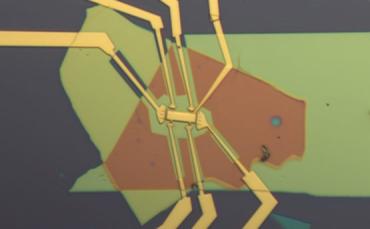
Stanford physicists, while trying to replicate another team's findings, discovered a novel form of magnetism generated when two honeycomb-shaped lattices of carbon are carefully stacked and rotated to a special angle. “I thought the discovery of superconductivity in this system was amazing. It was more than anyone had a right to expect,” Prof. Goldhaber-Gordon said. The researchers propose that the magnetism, called orbital ferromagnetism, could be used in applications such as quantum computing.