
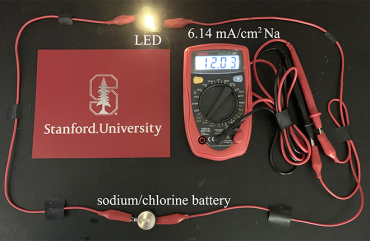
A new type of rechargeable alkali metal-chlorine battery developed at Stanford by an international team of researchers can store up to six times more charge than ones that are currently used today. The new battery relies on the back-and-forth chemical conversion of sodium chloride (Na/Cl2) or lithium chloride (Li/Cl2) to chlorine. Researchers envision their batteries to be used one day where frequent charging is not practical or desirable, such as in satellites or remote sensors. More work remains to engineer the battery structure for consumer electronics or electric vehicles.